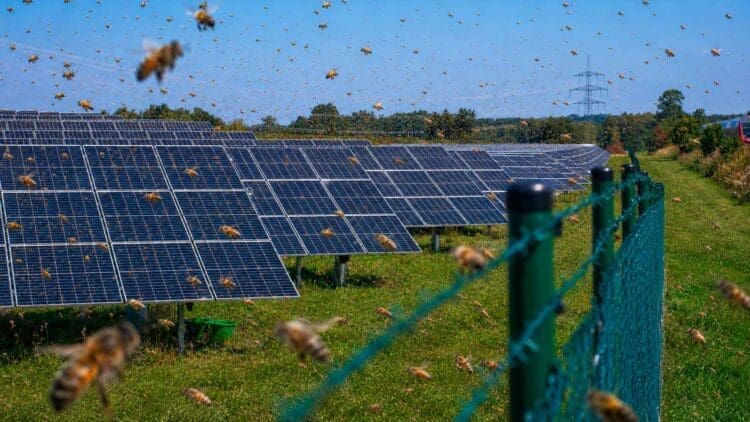

A new solar innovation at utility-scale plants now transforms the way bees survive and thrive in these environments.
This is important, as pollinator species populations are declining, leaving the world at risk of a food security crisis.
That is why researchers are exploring ways to integrate bee-friendly approaches into renewable energy facilities.


But if integrative solutions were truly meant to help raise population numbers, why did bees begin to drop dead?
How losing pollinators will affect the world
Years ago, many species could be seen roaming the planet in abundance.
However, as the human population began to grow, and towns and cities expanded, nature’s numbers began to decline.
This change was driven by the higher demand for food, resulting in a greater agricultural physical footprint.
Soon, industrialization accelerated this footprint, and as fossil fuel power plants became the norm, so did pollution.
The loss of natural vegetation, the use of harmful chemicals and pesticides, and a warmer planet affected vital species: pollinators.
As their numbers began to drop, experts became worried about the collapse of many ecosystems.
These insects are a vital food source for many species, but they are also fundamental for food security and quality.
Pollination affects nearly one-third of the world’s food sources, and without these insects, the risk of famine increases.
Offsetting carbon emissions became the sole solution, but it was not enough.
When climate targets fail to conserve biodiversity
Solar energy has become essential to the global transition to renewable energy.
Unfortunately, time does not stand still, and neither does modern technology in the Digital Age.
The rise of AI and cloud computing has led to substantial global power demand. Continuous AI training and data center cooling systems have put significant strain on critical infrastructure.
That is why the deployment of utility-scale solar plants with battery storage systems accelerated.
It meant that the delicate timing of nature had to make way for swift modern progress and meeting climate mandates. Vulnerable species had little to no time to adapt to these sudden environmental changes.
Then, researchers realized that solar plants create their own unique microclimates that attract thousands of insects, including pollinators.
However, in the UK, bees started to die at solar facilities. After investigation, Naturesave created an initiative to help save these bees while clean energy production continues.
A solar hive to make mites drop dead instead
The design of solar facilities cannot keep out all the natural enemies of crucial pollinators.
The investigation revealed that a microscopic enemy has found its way to the facility: the Varroa mite (Varroa destructor).
These mites are parasites that latch onto honeybees, feed on their fatty tissue, and transmit deadly viruses. The mites can wipe out an entire colony in one season.
Instead of depending on chemical treatments that affect bee fertility and honey quality, Naturesave created a thermal solution.
Using the solar energy to “cleanse” bee hives
The “Thermosolar” technology temporarily heats up the hives to approximately 108°F.
Varroa mites cannot survive temperatures above 104°F, and start dying inside the hives. The honeybees are more resilient, and can survive temperatures of up to 116.6°F for short periods.
The specially designed hives with solar collectors were the ideal thermal treatment to naturally reset the bee colony.
Utility-scale solar plants can be transformed into safe havens for bees and many other pollinators by using nature-positive management initiatives.
The success of the “Solar Bee Project” is perhaps the final piece to the true sustainability puzzle. It proved that micro-pests can be addressed with eco-friendly approaches.
By supporting up to three times more species than crops, solar panels effectively open the doors the biodiversity restoration.
Anke Maree is a writer with a clear and engaging editorial style. Her work focuses on making complex topics accessible, informative, and relevant for readers across different areas of interest.