
Millions of Indian reservoirs sat idle for decades, and now engineers are turning them into floating power plants
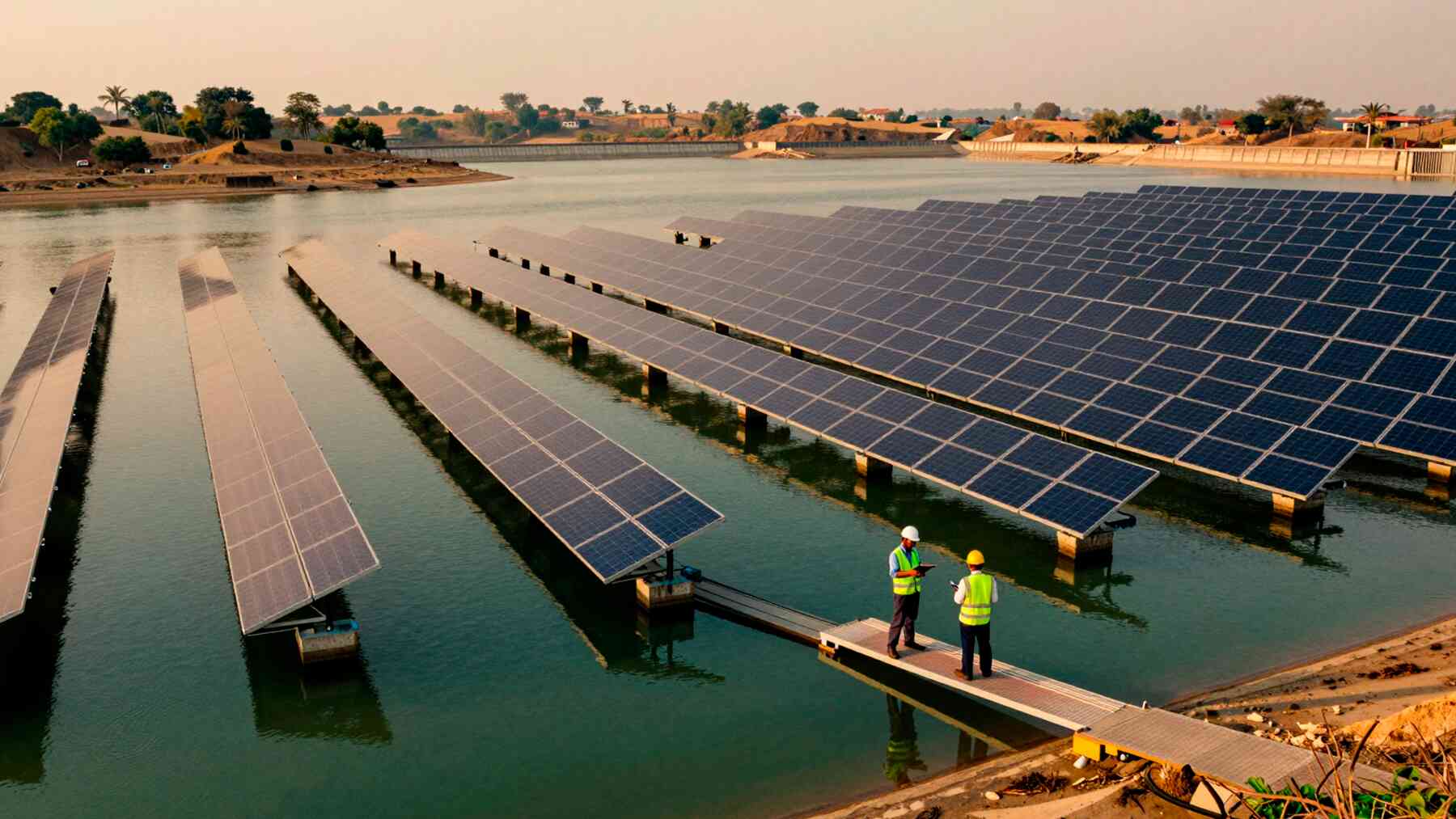
India has committed to reaching 500 GW of non-fossil fuel capacity — but the land to build it is running out. Flat, grid-connected terrain is already contested by agriculture, industry, and urban growth, leaving renewable developers searching for surfaces that don’t come with a land-acquisition battle.
The answer may have been sitting in plain sight for decades. Across the country, millions of reservoirs, irrigation ponds, and hydropower dams lie largely untapped as energy infrastructure. A quiet but accelerating shift is now underway to change that.
A renewable energy sector running out of land
India’s 500 GW non-fossil fuel target is ambitious by any measure. But ambition collides with a stubborn physical reality: the flat, grid-connected land needed for utility-scale solar is already claimed. Agriculture, industry, and urban expansion compete for the same terrain, and land acquisition disputes can delay or kill projects entirely.
Irrigation ponds carry a further dual benefit: reduced evaporation losses alongside direct power for pumps in water-stressed regions where both problems are acute.
Floating solar moved from niche experiment to mainstream solution precisely because it sidesteps that problem. Reservoirs, irrigation tanks, and hydropower dams offer large open surfaces, existing grid connections, and government ownership — a combination that simplifies permitting and accelerates deployment in ways ground-mounted projects rarely match.
Policy has reinforced the momentum. PM-KUSUM, MNRE floating solar targets, and active state-level tenders have created a structured investment environment. Falling panel prices have narrowed the cost gap with ground-mounted solar, and the economics are increasingly difficult to ignore.
Why reservoirs and hydropower dams lead the opportunity
Not all water bodies are equal. Reservoirs and hydropower dams currently offer the strongest near-term opportunity — particularly across Andhra Pradesh, Telangana, Karnataka, and Maharashtra, where large surface areas meet ready grid access and simplified land-use agreements.
Hydropower dams add a strategic dimension beyond surface area. Floating panels generate electricity during daylight hours while reducing water drawdown, preserving reservoir capacity for peak-demand periods. That hydro-solar hybridization improves the overall value of existing infrastructure without requiring major new investment.
Industrial water bodies are growing fast as a separate category. Companies with renewable purchase obligations want on-site generation without acquiring land, and floating solar on existing water bodies delivers exactly that. Irrigation ponds carry a further dual benefit: reduced evaporation losses alongside direct power for pumps in water-stressed regions where both problems are acute.
The cooling advantage: more than a talking point
The efficiency gains from water-surface deployment are real and quantifiable. Solar panels lose approximately 0.3–0.5% efficiency for every degree Celsius above 25°C. Ground-mounted panels in India regularly reach 60–70°C under direct sun — a drag on output that compounds across a project’s entire lifetime.
Floating solar’s evaporative cooling effect keeps panels meaningfully cooler, delivering a 5–15% yield improvement over land-based systems. Elevated panel layouts that improve natural airflow can add a further 2–3% energy gain in warm climates.
For a 100 MW project, a 5% yield gain equals 5 MW of additional effective generation — with no extra hardware. Compounded across a 25-year project lifespan, that translates into substantial additional revenue and a directly lower levelized cost of energy.
Engineering for storms, floods, and decades of operation
Climate resilience has become a central design priority. Rigorous site assessments now model peak gust wind speeds, wave action, and water-level fluctuations across the full 25-year operational life of a project. Averages are insufficient — the extremes are what drive structural and mooring design.
Triangular structural geometry — the same engineering principle used in bridge construction — distributes forces across the entire structure rather than concentrating stress at single points. That approach delivers greater stability under wind, wave, and thermal loading than earlier rigid-connection designs did.
Multi-point mooring systems can accommodate water-level variations of up to 20 meters while maintaining structural integrity, a critical capability at hydropower reservoirs where seasonal fluctuations are significant. Next-generation honeycomb-inspired platforms reduce wind-exposed surface area, improve fatigue resistance, and support modules up to 800 Wp — pushing the boundary of what utility-scale floating installations can achieve.
Supply chains, localization, and the road to gigawatt scale
Scaling floating solar to hundreds of megawatts introduces complexity that smaller projects simply don’t face. Anchoring systems must manage varied tension loads across non-uniform water depths, electrical architecture grows in intricacy, and on-water maintenance requires purpose-built solutions — including catamaran-based systems that allow safe access to every panel and cable without operators walking the array.
Supply chain volatility has added a separate layer of challenge. HDPE, the primary float material, is derived from crude oil, and geopolitical tensions have driven sharp increases in floating structure costs. Steel, mooring hardware, freight, and marine insurance have all risen alongside. Regional manufacturing development in India aims to reduce that dependence and improve project economics for developers.
Looking ahead, market growth will likely be shaped by battery co-location for improved dispatchability, aquaculture-integrated agrivoltaic models, and automated cleaning systems. India’s combination of extensive inland water bodies, high solar irradiance, policy momentum, and growing manufacturing capacity positions it to become one of the top three global floating solar markets within five years.

Carlos is an engineer with strong expertise in technical and industrial topics. He previously worked at international companies such as Siemens and is multilingual.
