
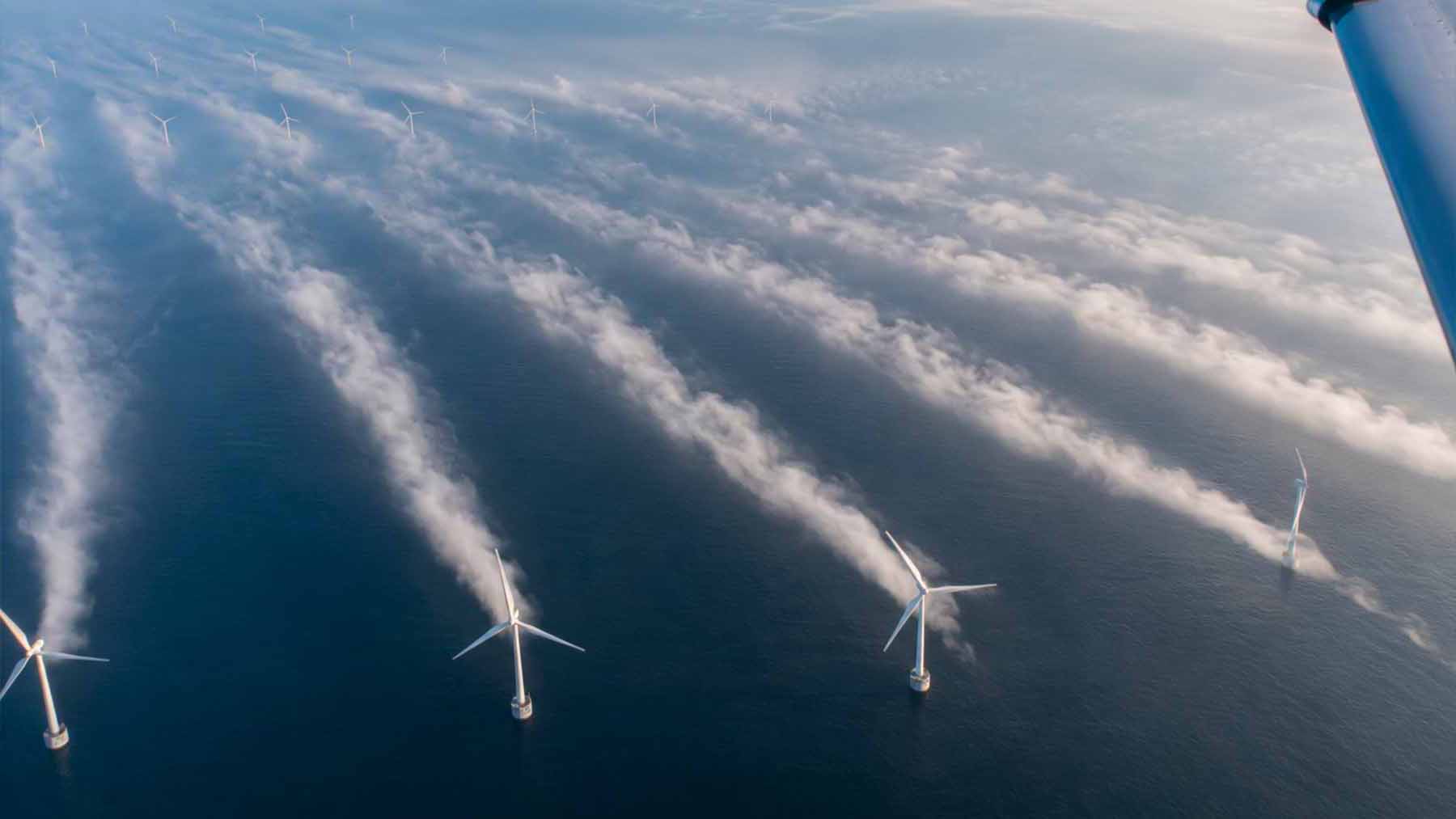
A pilot flying over Denmark looked out to sea and saw six-mile “ghost tails” stretching behind the wind turbines
 Credits: AI-made
A unique phenomenon trailing behind offshore wind turbines was observed over the North Sea.
Wind infrastructure is rapidly expanding across oceans worldwide as electricity consumption continues to rise.
Simultaneously, these structures are scaling to help nations meet strict climate targets.
However, before diving into projects headfirst, it is essential to understand how these wind turbines can alter the marine environment.
However, the giant installations ended up interacting with the local marine environments in surprising ways.
This raises the question: how did the offshore turbines end up creating those “ghostly” trails?
How wind energy over the ocean serves multiple purposes
In the Information Age, humanity is facing a dual challenge.
Rapidly advancing technology, along with a growing population, is skyrocketing global energy demand.
Simultaneously, these rising electricity needs are straining grids, making it impossible to shift away from fossil fuels just yet.
As greenhouse gas emissions continue to rise, several nations are falling behind in meeting international climate mandates.
This is despite major achievements in renewable energy capacity growth.
In 2025, global wind power exceeded 1.3 terawatts. Yet, future targets necessitate far more green electricity generation.
This goal faces significant challenges, primarily limited space.
By contrast, offshore wind offers vast installation space with stronger, more consistent winds.
Offshore wind turbines generate up to 50% more electricity compared to similar onshore turbines.
The elimination of transportation limits also enables the deployment of much larger turbines with higher capacities.
Moving offshore may bypass land-based obstacles, but it also leads to unexpected impacts.
Finding the balance between clean energy and environmental protection
Offshore wind power is undoubtedly crucial to meeting both climate targets and electricity demands.
However, before diving into projects headfirst, it is essential to understand how these wind turbines can alter the marine environment.
The installation of foundations on the seafloor disrupts soft-sediment species.
This, along with construction noise, temporarily disturbs local benthic ecosystems.
Interestingly, not all consequences are inherently negative.
After installation, the bases and scour protection rocks of the wind turbines begin acting as artificial reefs.
Mussels, barnacles, and kelp colonize by attaching to the hard, stable structures.
The new artificial habitats attract other small fish species and often larger marine predators.
The prohibition of commercial bottom trawlers around wind farms often transforms these areas into protected marine sanctuaries.
However, the impacts extend beyond the underwater environment.
On January 25, 2016, a pilot witnessed long, “ghostly” streams trailing behind offshore turbines on the North Sea.
The unexpected effect of wind turbines on the marine environment
The sight occurred over Denmark’s Horns Rev 2 offshore wind farm.
Behind the spinning wind turbines were thin trails stretching across the ocean for nearly six miles.
Researchers investigating the visual phenomenon discovered a delicate meteorological balance was at play. When disrupted, significant wakes formed at the offshore wind farm.
The formation of the ghost tails behind the turbines
Cold, saturated fog sits less than 65 feet above the sea surface. Above the cold fog is a layer of warmer, drier air.
The rotating blades create sudden pressure drops behind the rotors as they mix the air layers.
Cold, humid air is forced upward into the rotor zone.
Invisible moisture instantly condenses into liquid water droplets.
Over the smooth ocean surface, nothing breaks up the flow, causing turbulent “wake clouds” to remain intact for miles.
Downwind, the turbine motion continues to mix warmer, drier air into the fog.
This heat evaporates the droplets into invisible vapor, dissolving the long tails.
These unique fog lines are more than just a striking appearance.
The wake clouds reveal important aerodynamic information for wind infrastructure.
Researchers and developers will be able to map turbulent zones more accurately. This data can be leveraged to optimize wind turbine spacing and rotor alignments over the ocean.
This will help future offshore wind deployment minimize atmospheric drag and “wind theft,” ensuring maximum power output.
Anke Maree is a writer with a clear and engaging editorial style. Her work focuses on making complex topics accessible, informative, and relevant for readers across different areas of interest.
