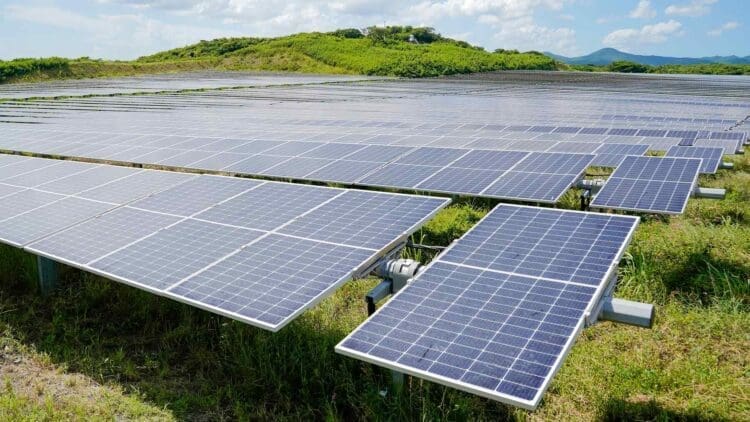

Cambridgeshire’s solar plant was set to become a UK renewable energy centerpiece, but then a lost city was discovered.
For too long, fossil fuels have dominated the nation’s grid, with the costs being greater than most would think.
Now, climate goals have been set to help move along the transition, with capacity having grown significantly.



But will the UK’s move toward a cleaner future end up compromising its ancient history?
How the UK’s energy portfolio has transformed over the years
For decades, the UK’s industrial revolution was driven by coal.
The nation’s dependency, unfortunately, reached a tragic pivot point during the Great Smog of London in 1952.
A thick, toxic layer of soot and sulfur dioxide trapped the city. Operations were brought to a standstill, and thousands of premature deaths took place.
This grim air pollution event was a much-needed wake-up call about the true cost of reliance on coal.
Eventually, the Clean Air Act of 1956 was legislated, moving the nation toward cleaner heating and power sources.
By the late 20th century, natural gas was the primary fuel for electricity, but it was still not green enough.
The global climate crisis necessitated a vital transition, paving the way for the expansion of the UK’s renewable infrastructure.
The end of one era opens the door to the next
The nation’s transition away from carbon-heavy fuels reached a pinnacle point in September 2024.
The Ratcliffe-on-Soar Power Station was decommissioned, marking the end of the UK’s 142-year-old relationship with coal-fired electricity.
It became the first G7 nation to phase out coal completely, shifting its focus entirely toward its climate goals.
Solar and wind have become integral to achieving a decarbonized grid by 2035, with record-breaking solar farms being greenlit.
The UK also aims to have installed 45-47 GW of solar capacity by 2030.
However, while capacity may have grown significantly, the nation’s renewable energy sector has faced a few obstacles.
Its wind sector has taken the hardest hits, essentially leaving solar to pick up the pace to meet climate deadlines.
But sometimes, the past can put a stop to future ambitions.
This was the case in Cambridgeshire, when Historic England acted as the arbiter between progress and preservation.
A solar plant’s future is in the hands of the past
Environmental impact studies for potential solar plants are crucial to understanding what could be left hanging in the balance.
In the case of the East Park Energy project, the AOC Archaeology Group discovered something of extreme historical significance.
A survey of the 77-acre site near Great Staughton was conducted using geophysical sensors and aerial photography. This led to the discovery of a 1,600-year-old well-preserved Roman town.
The fight to preserve an ancient “highly organized” urban center
The site had a network of structured streets all leading from a central marketplace. Evidence of blacksmith forges and pottery kilns along the outer perimeter suggests the presence of industrial zones.
Many other artifacts were found, including thousands of coins, jewelry, and iron objects.
Historic England advised the government of the site’s national importance and helped secure the Scheduled Monument status.
This highest level of legal protection forced the solar plant developers to alter the development plans. As a result, nearly 76 acres were removed from the solar plant’s layout to preserve the land’s history.
Great Staughton’s discovery of the lost city proves that the global energy transition is far more complex than initially believed.
It is not just about saving the environment anymore. The industry must now ensure that the past is not erased to make way for the future.
Responsible renewable site management is key to ensuring sustainability and cultural preservation. This way, nations such as the UK can break away from fossil fuels while saving their heritage.
Anke Maree is a writer with a clear and engaging editorial style. Her work focuses on making complex topics accessible, informative, and relevant for readers across different areas of interest.