
WSU researchers develop chemical-free recycling process for wind turbine blades that yields stronger plastics
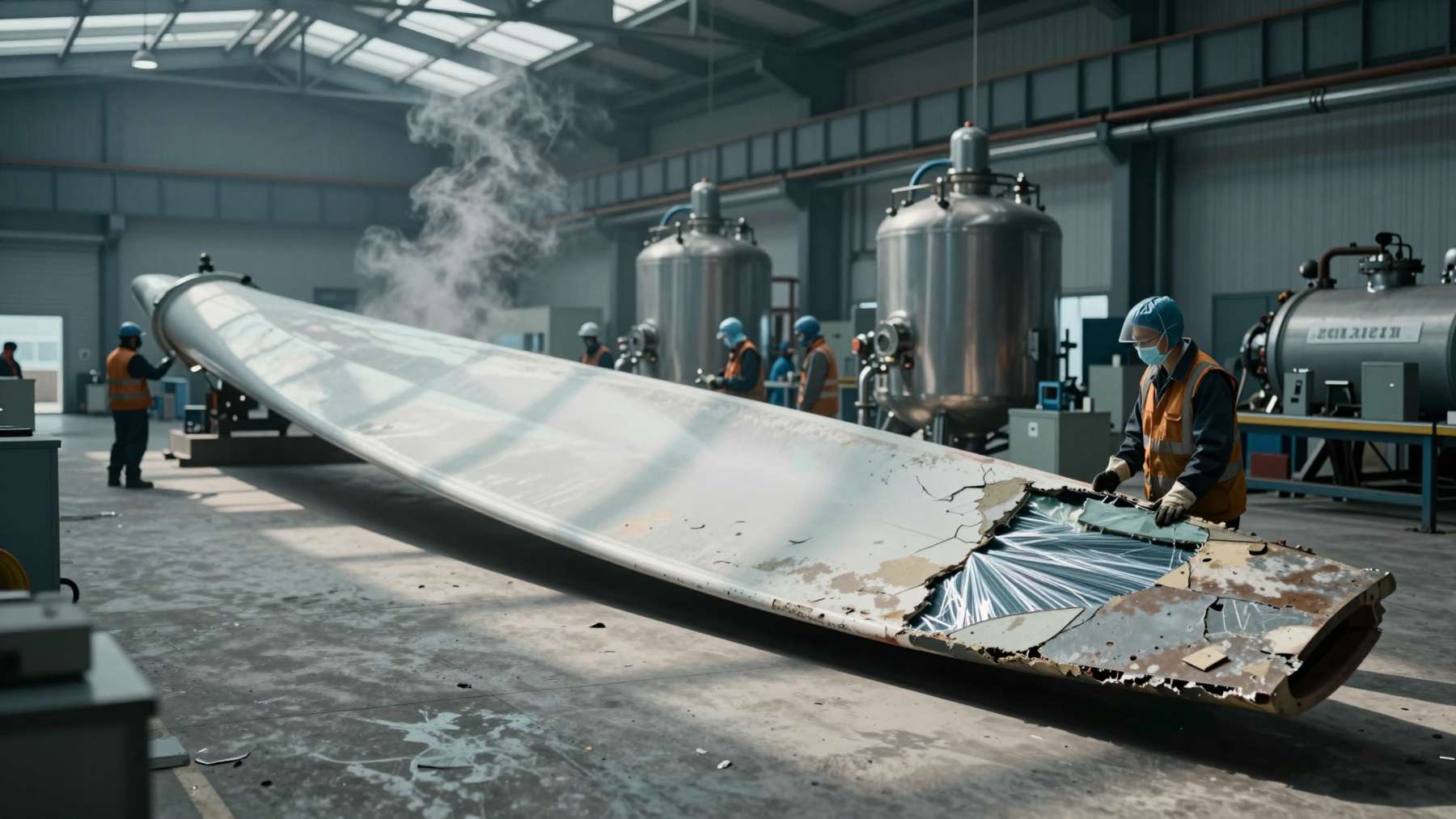 AI-made
Wind turbine blades have long posed a stubborn recycling problem — too tough to melt down, too bulky to ignore. Now, researchers at Washington State University say they’ve found a way through it.
In a study published April 3 in Resources, Conservation and Recycling, the team describes a low-toxicity method to break down glass fiber-reinforced polymer blades and recover their materials intact — fibers and resins that can be repurposed to make plastics significantly stronger than the originals.
New recycling method recovers blade materials without harsh chemicals
The WSU team’s approach is straightforward in concept. Researchers cut glass fiber-reinforced polymer (GFRP) blade material into roughly two-inch blocks, then submerged them in a solution of zinc acetate — a mild organic salt also found in throat lozenges and food additives — mixed with pressurized, superheated water. After about two hours, the composite’s cross-linked molecular network broke apart without requiring aggressive chemical conditions.
The process, he noted, does not require pushing the reaction to full completion — breaking the cross-linked network into smaller, melt-processable pieces is enough.
“It works very well, especially considering the mild conditions that we applied,” said Cheng Hao, a former graduate student and co-first author on the paper. “The solvent is a green solvent, and also the temperature is acceptable for this purpose.”
Glass fibers and resins came out in good condition, ready to blend directly with thermoplastics. Researchers skipped fiber-resin separation entirely, mixing the recovered material straight into new plastic formulations. Most of the zinc acetate catalyst could also be reclaimed through basic filtration and reused — a detail that strengthens the method’s cost case. The study was funded by the Department of Energy’s Office of Energy Efficiency and Renewable Energy.
Why wind turbine blades have been difficult to recycle
The core problem is chemistry. Wind turbine blades are built primarily from GFRP composites, which rely on thermoset resins. Unlike thermoplastics — the material in a milk jug, which can be melted and remolded — thermosets cure into a fixed structure. Once set, they resist being broken back down, making conventional recycling routes largely ineffective.
The scale compounds the difficulty. GFRP makes up roughly two-thirds of a blade’s total weight, and about 15% of blade material is lost as waste during manufacturing itself.
Timing adds urgency. The first generation of composite wind turbines, built in the 1990s, is now reaching the end of its operational life. That wave of decommissioned blades represents a large and growing disposal challenge — one the industry has not yet solved at scale.
Recycled material makes nylon more than three times stronger
The recovered material does not just avoid the landfill — it measurably improves the plastics it enters. When researchers blended recycled GFRP into nylon and ran mechanical tests, the nylon became more than three times stronger and more than eight times stiffer than standard nylon.
The team produced composite plastics containing up to 70% recycled glass fiber material — a high loading fraction suggesting the recovered fibers retain meaningful structural integrity through the recycling process. The method also works with polypropylene and with plastics used in everyday consumer goods like milk jugs and shampoo bottles, which broadens the potential market for recovered material considerably.
“We are not separating the resin from the fiber — we just blend everything with nylon and get a new composite,” said Baoming Zhao, co-first author and research assistant professor at WSU’s Composite Materials and Engineering Center. The process, he noted, does not require pushing the reaction to full completion — breaking the cross-linked network into smaller, melt-processable pieces is enough.
Scale-up potential and next steps
The research team describes the method as scalable and cost-effective, designed with large-volume blade waste in mind. Corresponding author Jinwen Zhang, a professor in WSU’s School of Mechanical and Materials Engineering, called it “a sustainable solution for reusing large quantities of glass fiber reinforced waste” as wind energy continues to expand globally.
Work is ongoing to simplify the process, particularly by reducing pressurization requirements. Lower pressure thresholds would make the method cheaper and easier to deploy at industrial scale — two factors that matter enormously once you’re talking about thousands of decommissioned blades.
WSU’s Office of Commercialization is also involved, with a longer-term goal of developing blade materials that are fully recyclable by design, addressing the problem at the source rather than at end of life.
A mild zinc acetate solution in pressurized water can break down GFRP blade material in about two hours. The recovered fibers and resins reinforce thermoplastics into significantly stronger composites, and the catalyst is largely recoverable. As wind energy capacity grows worldwide, methods like this one may become central to managing the material legacy of the industry’s first decades.

Carlos is an engineer with strong expertise in technical and industrial topics. He previously worked at international companies such as Siemens and is multilingual.
